Events Toscana
Arezzo Firenze Grosseto Livorno Lucca Massa-Carrara Pisa Pistoia Prato Siena
The Cradle of the Renaissance
Tuscany is one of Italy's most famous and fascinating regions, located in central Italy and overlooking the Tyrrhenian Sea. With its capital, Florence, Tuscany represents the cradle of the Italian Renaissance and one of the world's most important cultural and artistic centers. The region offers an extraordinary variety of landscapes, ranging from sandy and rocky coasts to terraced hills, from medieval villages perched on heights to the mountains of the Apennines, from art cities to lush countryside. Tuscany is famous for its art, history, culture, nature, and cuisine, making it one of Italy's and the world's most sought-after tourist destinations.
History and Cultural Heritage
Tuscany's history is rich and fascinating, with evidence dating back to the Etruscan era. The Etruscans, one of Italy's oldest and most mysterious civilizations, left an indelible mark on the region, with necropolises, tumuli, and cities such as Tarquinia, Cerveteri, and Volterra. During the Roman era, Tuscany was an important commercial and military center, as evidenced by the ruins of cities such as Pisa (with its Leaning Tower and Campo dei Miracoli) and Lucca (with its Roman Amphitheatre and medieval walls).
In the Middle Ages, Tuscany was characterized by the presence of numerous maritime republics and city-states, such as the Republic of Florence, the Republic of Siena, the Republic of Pisa, and the Republic of Lucca, which left a profound mark on the region's art, culture, and architecture. The Renaissance, in particular, saw the birth in Florence of some of the greatest artists and intellectuals of all time, such as Dante Alighieri, Giotto, Masaccio, Donatello, Botticelli, Leonardo da Vinci, and Michelangelo Buonarroti.
Among the most important monuments are Florence Cathedral (with Brunelleschi's dome), the Uffizi Gallery (housing one of the world's richest collections of Italian painting), and the Accademia Gallery (which exhibits Michelangelo's David). Other historic centers of great charm include Siena (with its Piazza del Campo, where the famous Palio horse race is held, and its Cathedral), San Gimignano (with its medieval towers), and Pienza (with its Renaissance historic center).
Art and Traditions
Tuscany is a region rich in artistic and cultural traditions. Florence, the regional capital, is an open-air art city with a rich heritage of churches, palaces, museums, squares, and monuments spanning from the Etruscan era to the present day. Among the most important places are the Ponte Vecchio, the Palazzo Vecchio, the Pitti Palace (with its Boboli Gardens), and the Bargello (which houses one of the richest collections of Italian sculpture). The city is also famous for its Teatro del Maggio Musicale Fiorentino, one of Italy's most prestigious lyric theaters.
Other cultural centers of great relevance include Pisa (with its Monumental Cemetery and the Opera del Duomo Museum) and Arezzo (with its Piazza Grande and the National Museum of Medieval and Modern Art). Tuscan popular traditions are deeply connected to music, theater, and folklore. Among the most evocative events are the Palio di Siena (a horse race held twice a year, in July and August, representing one of Italy's oldest and most fascinating traditions) and the Feast of St. John in Florence (held in June and including a series of cultural and religious events).
Traditional Tuscan music and dance include the "moresca" (a ritual dance dating back to the Middle Ages) and the "saltarello" (a couple's dance performed during village festivals). Local crafts include pottery, wood, wrought iron, textile, and leather work, with products reflecting the region's ancient traditions. Particularly renowned are the pottery of Montelupo Fiorentino, the wooden furniture of Sesto Fiorentino, and the leather products of Santa Croce sull'Arno.
Nature and Environment
Tuscany offers an extraordinary variety of natural landscapes. The Tuscan coasts, stretching approximately 400 kilometers, offer an extraordinary variety of coastal landscapes, from the sandy beaches of Forte dei Marmi, Viareggio, and Castiglione della Pescaia to the rocky cliffs of Elba Island and the Maremma Nature Park. Elba Island, in particular, is famous for its beaches, crystal-clear waters, and natural landscapes, as well as being the place of Napoleon Bonaparte's exile.
The Tuscan hinterland is characterized by hills and mountains offering stunning rural landscapes. Chianti, with its vineyards and medieval villages, represents one of Tuscany's most iconic landscapes, with its panoramic roads, wine cellars, and food and wine products. The Cinque Terre National Park (which also extends into Liguria) protects unspoiled nature with hiking trails connecting the five villages of Monterosso al Mare, Vernazza, Corniglia, Manarola, and Riomaggiore.
The Val d'Orcia, with its hilly landscapes, cypress trees, and medieval villages such as Pienza, Montalcino, and San Quirico d'Orcia, represents another of Tuscany's most suggestive landscapes, so much so that it has been declared a UNESCO World Heritage site. The Marecchia Nature Park, located in the hinterland of the province of Arezzo, protects unspoiled nature with forests, meadows, and rich biodiversity. The Apuan Alps, with their imposing peaks such as Monte Pisanino (1,946 meters) and Monte Tambura (1,895 meters), represent a paradise for trekking, mountaineering, and speleology enthusiasts, with caves such as the Antro del Corchia (one of Italy's largest).
Food and Wine
Tuscan cuisine is one of the most famous and appreciated in Italy and the world, with dishes reflecting the simplicity and genuineness of its ingredients. Among the most famous dishes are ribollita (a soup made with bread, vegetables, and beans), pappa al pomodoro (a soup made with bread, tomato, and basil), and pici (fresh pasta made with flour and water, served with duck sauce or aglione, a sauce made with garlic and extra virgin olive oil). Second courses include "bistecca alla fiorentina" (a grilled beef steak), "cinghiale in umido" (wild boar stew cooked with red wine and spices), and "trippa alla fiorentina" (a dish of beef tripe cooked with tomato and cheese).
Tuscan cured meats are world-renowned: among these are Tuscan prosciutto, Tuscan salami, and finocchiona (a salami made with pork and fennel seeds). Cheeses include Pecorino Toscano (a hard cheese made with sheep's milk) and Marzolino (a soft cheese made with sheep's milk). Tuscan traditional desserts are equally delicious: among these are "cantucci" (dry biscuits made with flour, eggs, sugar, and almonds), "panforte" (a sweet made with dried fruit, honey, and spices), and "ricciarelli" (sweets made with almonds, sugar, and egg white).
Tuscan wines are among the world's most prestigious: among these are Chianti DOCG, Brunello di Montalcino DOCG, Vino Nobile di Montepulciano DOCG, and Vernaccia di San Gimignano DOC. Tuscan extra virgin olive oil, produced with Frantoio, Leccino, and Moraiolo cultivars, is one of Italy's most prestigious and represents another strength of the region. Tuscany is also famous for its bakery products, such as Tuscan bread (unsalted and plain), and for its mushrooms, such as porcini and ovuli, which grow abundantly in its forests.
Expand1 result found
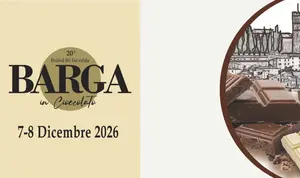
07/12/2026 08/12/2026
Festivals
The village of Barga celebrates the twentieth edition of Barga in Cioccolato. A journey through confectionery craftsmanship and Christmas atmosphere on December 7th and 8th, 2026.