Events Sicilia
Agrigento Caltanissetta Catania Enna Messina Palermo Ragusa Siracusa Trapani
The Island of the Sun
Sicily is the largest island in the Mediterranean Sea and one of Italy's most fascinating and history-rich regions. Located at the southern tip of the Italian peninsula, Sicily offers an extraordinary variety of landscapes ranging from rugged, jagged coasts to golden sandy beaches, from the Etna mountains to the hinterland hills, from medieval villages to ancient Greek and Roman cities. With its capital, Palermo, Sicily is a region that boasts a unique culture, flavorful cuisine, and unspoiled nature, making it an ideal destination for travelers seeking adventure, art, and authentic traditions.
History and Cultural Heritage
Sicily's history is millennia-old and fascinating, with evidence dating back to prehistoric times. The island has been the cradle of important civilizations, such as the Sicels, Phoenicians, Greeks, Romans, Byzantines, Arabs, Normans, Swabians, and Aragonese, each of whom left an indelible mark on the region's artistic and architectural heritage. Among the most important archaeological sites are the Valley of the Temples in Agrigento (a complex of Greek temples among the best preserved in the world and a UNESCO World Heritage site), the Greek Theatre of Syracuse (the largest theater of classical antiquity), and the Roman Villa of Casale in Piazza Armerina (famous for its mosaics depicting scenes of daily life).
During the Norman period, Sicily experienced an era of great cultural and artistic splendor, as evidenced by the Cathedral of Monreale (with its Byzantine mosaics), the Norman Palace in Palermo, the Cathedral of Palermo, and the Church of San Cataldo. In the Baroque period, Sicily was characterized by the reconstruction of numerous cities after the 1693 earthquake, such as Noto, Modica, Ragusa, and Scicli, which today represent some of Italy's most beautiful Baroque cities, also UNESCO World Heritage sites.
Art, Culture, and Traditions
Sicily is a region rich in artistic and cultural traditions. Palermo, the regional capital, is a city of art and culture with a rich heritage of churches, palaces, and monuments spanning from the Arab-Norman period to the Baroque. Among the most important places are the Massimo Theatre (one of Europe's largest lyric theaters), the Regional Archaeological Museum (housing one of the richest collections of Greek, Roman, and Punic artifacts), the Palermo Cathedral (with its royal tombs), and the Royal Palace (with its Palatine Chapel, famous for its Byzantine mosaics).
Other cultural centers of great relevance include Catania (with its Roman Theatre, Benedictine Monastery, and Fish Market) and Syracuse (with its Greek Theatre, Eurialo Castle, and Temple of Apollo). Sicily also boasts numerous medieval villages, such as Taormina (with its Greek Theatre and Corso Umberto), Erice (with its castle and alleys), and Cefalù (with its Norman Cathedral and Rocca). Sicilian popular traditions are deeply connected to religion, folklore, and ancient pagan customs. Among the most evocative events are the Feast of Santa Rosalia in Palermo (held in July, including a procession with the saint's statue carried through the city's streets) and the Feast of Sant'Agata in Catania (held in February, including a procession with the saint's statue and "candorini," large decorated wax candles).
Traditional Sicilian music and dance include "cantu a ballu" (a chant accompanied by traditional dances) and "tarantella siciliana" (a ritual dance performed during village festivals). Local crafts include pottery, wood, wrought iron, textile, and "pupi" (marionette) work, with products reflecting the island's ancient traditions. Particularly renowned are Sicilian pupi (wooden marionettes depicting knights used for "Misteri" performances), the Puppet Theatre (declared an intangible UNESCO World Heritage), and the pottery of Caltagirone (famous for its majolica and "presi").
Nature and Environment
Sicily offers an extraordinary variety of natural landscapes. Mount Etna, Europe's tallest active volcano at 3,326 meters, dominates the island's eastern part and represents a symbol of Sicily. Etna Park, which protects unspoiled nature with hiking trails leading to the volcano's craters, lava flow caves, lakes, and rich biodiversity, is one of Italy's most fascinating parks. The Sicilian coasts, stretching approximately 1,000 kilometers, offer an extraordinary variety of coastal landscapes, from golden sandy beaches such as San Vito Lo Capo, Mondello, and Isola Bella in Taormina, to rugged, jagged cliffs such as those of Scala dei Turchi, Capo d'Orlando, and the Zingaro Nature Reserve.
The Aeolian Islands, a volcanic archipelago of seven islands located north of Sicily, represent a unique natural oasis with crystal-clear waters, black volcanic sand beaches, and rich biodiversity. The Etna Regional Nature Park protects one of Europe's largest volcanic areas, with rich biodiversity including rare species such as Sicilian astragalus and Etna birch. The Egadi Islands, an archipelago of three islands located west of Sicily, represent another natural wonder of the region, with crystal-clear waters and exceptionally beautiful maritime landscapes.
Food and Wine
Sicilian cuisine is one of the most famous and appreciated in Italy, with dishes reflecting the island's richness and variety, resulting from the encounter of different cultures and civilizations. Among the most famous dishes are "pasta alla Norma" (a first course of pasta, eggplant, salted ricotta, and basil), "arancini" (rice balls stuffed with ragù, mozzarella, and peas), and "caponata" (a dish made with eggplant, capers, olives, tomato, and sweet-and-sour sauce). Second courses include "pesce spada alla ghiotta" (swordfish cooked with tomato, olives, capers, and potatoes), "involtini di pesce spada" (swordfish rolls), and "stufato di manzo alla siciliana" (beef stew cooked with tomato, olives, and capers).
Sicilian traditional desserts are world-famous: among these are "cannoli" (crispy pastry shells filled with sweetened ricotta), "cassata siciliana" (a dessert made with sponge cake, ricotta, candied fruit, and marzipan), and "gelato" (with unique flavors such as Bronte pistachio and black mulberry). Sicilian cheeses include Pecorino Siciliano (a hard cheese made with sheep's milk), Ragusano (a stretched curd cheese), and Tuma Persa (a soft cheese). Cured meats include Sicilian salami and sausage.
Sicilian wines are among Italy's most prestigious: among these are Nero d'Avola DOC, Cerasuolo di Vittoria DOCG, Etna DOC, and Marsala DOC. Sicily is also famous for its extra virgin olive oil production (with cultivars such as Tonda Iblea, Nocellara del Belice, and Moresca) and for its citrus fruits (such as Sicilian red oranges, Syracuse lemons, and Ciaculli mandarins). Sicilian granita, served with brioche, represents one of the island's most typical and appreciated breakfasts.
Expand3 results found
17/10/2026 19/10/2026
Festivals
The 17th edition of the Beauty & Fitness Show transforms Sicilia Fiera into a hub for wellness professionals, covering aesthetics, hairstyling, and technique.

29/10/2026 01/11/2026
Festivals
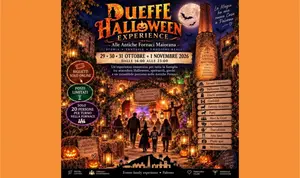
From October 29th to November 1st, 2026, the Antiche Fornaci Maiorana in Palermo will host a themed event dedicated to culture and family entertainment.
14/11/2026 15/11/2026
Festivals
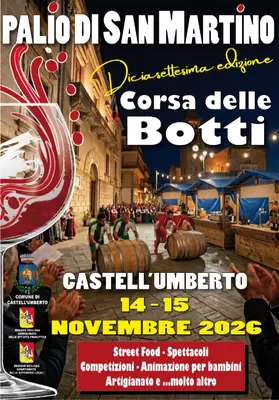
The village of Castell’Umberto celebrates the seventeenth edition of the San Martino Palio amidst historical reenactments, local gastronomy, and the Barrel Race.