Events Lombardia
Bergamo Brescia Como Cremona Lecco Lodi Mantova Milano Monza e Brianza Pavia Sondrio Varese
Italy's Engine
Lombardy is a region in northern Italy that stretches from the Po Valley to the Alps, with Milan as its capital. With its strategic position at the center of Europe, Lombardy represents Italy's economic and productive engine, thanks to a dynamic and innovative business fabric. The region offers an extraordinary variety of landscapes, ranging from the fertile countryside of the Po Valley to the mountains of the Lombard Alps, from pre-Alpine lakes such as Lake Como, Lake Garda, and Lake Maggiore to morainic hills and historic villages. Lombardy is a region rich in history, art, culture, and culinary traditions.
History and Cultural Heritage
The history of Lombardy is rich and fascinating, with evidence dating back to prehistoric times. During the Roman era, the region was an important commercial and military center, as evidenced by the ruins of Mediolanum, the ancient name of Milan, which was the capital of the Western Roman Empire. Even today, it is possible to admire the archaeological remains of this era, such as the Columns of San Lorenzo and the Roman baths of Milan.
In the Middle Ages, Lombardy was characterized by the presence of numerous lordships and free communes, such as the Commune of Milan, which dominated the political and military scene of northern Italy for centuries. Among the most important monuments are the Milan Cathedral, a masterpiece of Gothic architecture, the Sforza Castle, the Basilica of Sant'Ambrogio, and the Church of Santa Maria delle Grazie, which houses the famous fresco of "The Last Supper" by Leonardo da Vinci. The region also boasts a rich Renaissance and Baroque heritage, with churches, palaces, and squares reflecting the opulence and culture of Lombard cities.
Art and Culture
Lombardy is a region rich in artistic and cultural traditions. Milan, the regional capital, is a city of art and culture with a rich heritage of churches, palaces, theaters, and museums spanning from the medieval period to the present day. Among the most important places are the Teatro alla Scala, one of the world's most famous lyric theaters, the Brera Art Gallery, which houses one of the richest collections of Italian painting, and the Museum of the Twentieth Century, which exhibits modern and contemporary artworks.
Other cultural centers of great relevance include Bergamo, with its Upper Town (Città Alta), a medieval village perched on a hill, and the Basilica of Santa Maria Maggiore, and Brescia, with its Roman Forum, Roman Theatre, and Old Cathedral. Lombardy also boasts numerous historic villages, such as Mantua, with its Ducal Palace and the Palazzo Te, and Cremona, with its Cathedral and the Violin Museum, dedicated to the city's lute-making tradition.
Lombard popular traditions are deeply connected to music, theater, and folklore. Among the most evocative events are the Carnival of Milan, with its masks and allegorical floats, and the Naviglio Festival in Milan, held in June and featuring a series of cultural and musical events. Traditional music and dance include the "furlana," a couple's dance dating back to the Renaissance, and the "monferrina," a ritual dance performed during village festivals.
Nature and Environment
Lombardy offers an extraordinary variety of natural landscapes. The pre-Alpine lakes, such as Lake Como, Lake Garda, and Lake Maggiore, represent one of the region's main tourist attractions, with their crystal-clear waters, rugged coasts, and picturesque villages. Lake Como, in particular, is famous for its historic villas, such as Villa del Balbianello, Villa Carlotta, and Villa d'Este, and for its landscapes that have inspired poets and writers from around the world.
The Lombard Alps, with their imposing peaks such as Bernina (4,061 meters), Monte Disgrazia (3,678 meters), and Pizzo Bernina, represent a paradise for trekking, mountaineering, and winter sports enthusiasts. The Stelvio National Park, Italy's largest national park, protects unspoiled nature, with hiking trails, alpine lakes, and rich biodiversity including rare species such as chamois, roe deer, and golden eagle.
The morainic hills, such as those of Franciacorta and Oltrepò Pavese, offer stunning rural landscapes, with vineyards, olive groves, and historic villages. The Ticino Valley Nature Park protects one of Italy's last unspoiled river areas, with rich biodiversity and hiking trails crossing forests, meadows, and wetlands.
Food and Wine
Lombard cuisine is one of the most famous and appreciated in Italy, with dishes reflecting the region's richness and variety. Among the most famous dishes are risotto alla milanese (a first course made with rice, saffron, butter, and cheese), cotoletta alla milanese (a breaded and fried veal cutlet), and cassoeula (a dish made with cabbage, pork meat, and cured meats). Second courses include "brasato al Barolo" (a dish of beef cooked slowly with Barolo wine), "ossobuco alla milanese" (a dish of veal shank cooked with vegetables and white wine), and "polenta e osei" (a dish of polenta and small birds).
Lombard cheeses are world-renowned: among these are Gorgonzola (a blue-veined cheese made with cow's milk), Grana Padano (a hard cheese), and Taleggio (a soft cheese). Cured meats include Varzi salami, Milan salami, and Bologna mortadella. Lombard traditional desserts are equally delicious: among these are "panettone" (a leavened sweet made with flour, butter, eggs, and candied fruit), "torrone" (a sweet made with honey, almonds, and eggs), and "mostaccioli" (biscuits made with honey, almonds, and spices).
Lombard wines, such as Franciacorta DOCG, Oltrepò Pavese DOC, and Valcalepio DOC, complete the region's culinary offerings, providing perfect pairings with local dishes.
Expand3 results found
15/10/2026 25/10/2026
Festivals
Two weekends dedicated to promoting pumpkins through a food and wine journey that celebrates the agricultural excellence of the Mezzago region.

29/10/2026 01/11/2026
Festivals
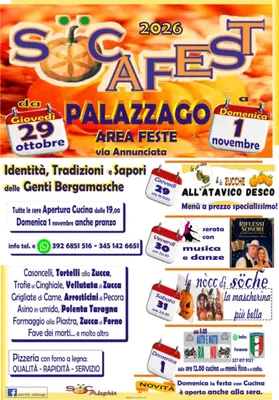
From October 29th to November 1st, Palazzago celebrates Bergamasque identity with an event dedicated to local culinary tradition and moments of cultural gathering.
31/10/2026 01/11/2026
Festivals
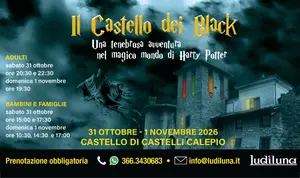
An interactive narrative adventure within the walls of Castelli Calepio. On October 31st and November 1st, 2026, a magical challenge to preserve the balance of the world.