Events Lazio
Frosinone Latina Rieti Roma Viterbo
The Heart of Italy
Lazio is a region in central Italy that stretches from the Tyrrhenian Sea to the Apennines, with Rome as its capital. With its strategic position at the center of the peninsula, Lazio has always represented the political, religious, and cultural heart of Italy. The region offers an extraordinary variety of landscapes, ranging from the sandy coasts of the Latina province to the volcanic hills of the Alban Hills, from volcanic lakes like Lake Bracciano and Lake Bolsena to the mountains of the Apennines such as the Simbruini and Ernici Mountains. Lazio is a region rich in history, art, culture, and culinary traditions.
History and Cultural Heritage
The history of Lazio is the history of Italy itself, with evidence dating back to prehistoric times. During the Roman era, the region was the center of the Roman Empire, and even today, it is possible to admire the extraordinary ruins of this civilization, such as the Colosseum, the Roman Forum, the Pantheon, and the Circus Maximus in Rome. The Eternal City, with its monuments, churches, and squares, represents an open-air museum where every corner holds centuries of history.
Outside Rome, Lazio boasts a rich archaeological heritage, such as the excavations of Ostia Antica, the ancient port of Rome, and the Roman villas of Tivoli, including Hadrian's Villa and the Villa d'Este, both UNESCO World Heritage sites. During the Middle Ages, Lazio was characterized by the presence of numerous lordships and pontifical states, which left an indelible mark on the region's artistic and architectural heritage. Among the most important monuments are the Orsini-Odescalchi Castle in Bracciano, the Farnese Palace in Caprarola, and the Cathedral of Anagni.
Art and Traditions
Lazio is a region rich in artistic and cultural traditions. Rome, the regional and national capital, is a city of art and culture with a rich heritage of churches, palaces, fountains, and monuments spanning from antiquity to the present day. Among the most important places are St. Peter's Basilica in the Vatican, the Sistine Chapel, the Trevi Fountain, Piazza Navona, and the Pantheon. The city is also an important center for cinema, theater, and music, with institutions such as the Accademia Nazionale di Santa Cecilia and the Teatro dell'Opera di Roma.
Lazio's popular traditions are deeply connected to religion and folklore. Among the most evocative events are the Festa de' Noantri in Trastevere, held in July in honor of Our Lady of Mount Carmel, and the Feast of St. Cecilia in Rome, patron saint of musicians. Traditional music and dance include the "saltarello," a couple's dance dating back to the Middle Ages, and the "Roman tarantella," a ritual dance performed during village festivals. Local crafts include marble, wood, and textile work, with products reflecting the region's ancient traditions.
Nature and Environment
Lazio offers an extraordinary variety of natural landscapes. Circeo National Park, located on the Tyrrhenian coast, protects unspoiled nature, with sand dunes, holm oak forests, and rich biodiversity including rare species such as wild boar and peregrine falcon. The Alban Hills, a group of volcanic hills located south of Rome, offer stunning landscapes with lakes like Lake Albano and Lake Nemi, and hiking trails that cross forests and meadows.
The Simbruini and Ernici Mountains, located in the Lazio hinterland, represent a paradise for trekking and mountain enthusiasts, with trails leading to peaks such as Mount Viglio (2,156 meters) and Mount Prenestino (1,279 meters). The Lazio coasts offer long stretches of fine sandy beaches, such as those in Ostia, Fregene, and Sabaudia, ideal for a beach holiday. The Pontine Islands, an archipelago of six volcanic islands located in the Tyrrhenian Sea, represent another natural wonder of the region, with crystal-clear waters and exceptional maritime landscapes.
Food and Wine
Lazio's cuisine is one of the most famous and appreciated in Italy, with dishes reflecting the region's richness and variety. Among the most famous dishes are carbonara (a first course made with pasta, eggs, guanciale, Pecorino Romano, and black pepper), amatriciana (a first course made with pasta, guanciale, tomato, and Pecorino Romano), and bucatini all'amatriciana. Second courses include "saltimbocca alla romana" (a dish made with veal, raw ham, and sage), "coda alla vaccinara" (a dish made with oxtail cooked with tomato and vegetables), and "gnocchi alla romana" (a dish made with semolina, milk, and cheese).
Lazio's cheeses are world-renowned: among these are Pecorino Romano (a hard cheese made with sheep's milk) and Marzolino (a soft cheese made with sheep's or goat's milk). Cured meats include guanciale (a cured meat made with pork cheek) and porchetta (a roasted pork stuffed with aromatic herbs and garlic). Lazio's traditional desserts are equally delicious: among these are "maritozzo" (a sweet made with leavened dough filled with whipped cream) and "bignè di San Giuseppe" (fried pastries filled with custard). Lazio's wines, such as Frascati DOC, Est! Est!! Est!!! di Montefiascone DOC, and Cesanese del Piglio DOCG, complete the region's culinary offerings.
Expand4 results found
08/09/2026 15/11/2026
Festivals
From September 8 to November 15, Rome hosts the Romaeuropa Festival, an event dedicated to contemporary artistic expressions including theater, dance, and visual arts.

01/11/2026 02/11/2026
Festivals
Ancient Pontine Flavors - Cooked Ham in Wine Festival November 2026 in Cori

07/11/2026 08/11/2026
Festivals
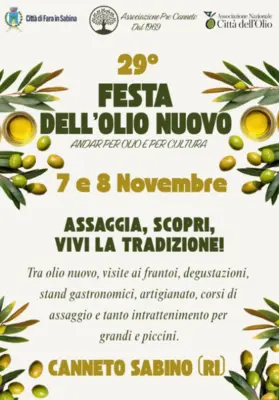
On November 7th and 8th, 2026, Canneto Sabino celebrates the 29th edition of the New Oil Festival, an event dedicated to promoting the excellence of local olive oil.