Events Puglia
Bari Barletta-Andria-Trani Brindisi Foggia Lecce Taranto
The Heel of Italy
Puglia is one of the most fascinating and characteristic regions of southern Italy, located at the southeastern tip of the peninsula, with its "heel" shape extending toward the Adriatic Sea and the Ionian Sea. With its capital, Bari, Puglia offers an extraordinary variety of landscapes ranging from long sandy beaches to rocky cliffs, from white villages perched on hills to expanses of centuries-old olive groves, from Baroque cities to "masserie" (ancient stone rural buildings). The region is famous for its intense light, vibrant colors, simple yet flavorful cuisine, and warm, genuine hospitality.
History and Cultural Heritage
Puglia's history is millennia-old and fascinating, with evidence dating back to prehistoric times. During the classical period, the region was colonized by the Greeks, who founded cities such as Taranto (one of Magna Graecia's most important colonies) and Egnazia (an important commercial and religious center). Even today, the archaeological remains of these ancient civilizations can be admired, such as the Temple of Poseidon in Taranto, the Greek Theatre of Egnazia, and the Aragonese Castle of Taranto.
In the Middle Ages, Puglia was characterized by the presence of numerous dominations, including the Byzantines, Lombards, Normans, Swabians, and Aragonese, each of whom left an indelible mark on the region's artistic and architectural heritage. Among the most important monuments are the Swabian Castle of Bari, the Basilica of San Nicola in Bari (which houses the remains of the city's patron saint), the Cathedral of Trani (a masterpiece of Romanesque architecture), and Frederick II's Castle in Castel del Monte (a masterpiece of medieval architecture and UNESCO World Heritage site).
Other historic centers of great charm include Lecce, with its Lecce Baroque (a unique architectural style that has made the city one of Italy's most beautiful), and Alberobello, with its "trulli" (ancient conical stone rural buildings), also a UNESCO World Heritage site. Puglia also boasts numerous medieval villages, such as Ostuni (the "White City," with its historic center entirely in white stone) and Otranto (with its Aragonese Castle and Cathedral, famous for its floor mosaic).
Art, Culture, and Traditions
Puglia is a region rich in artistic and cultural traditions. Bari, the regional capital, is a city of art and culture with a rich heritage of churches, palaces, and monuments spanning from the Roman period to the Baroque. Among the most important places are the Basilica of San Nicola, the Petruzzelli Theatre (one of Italy's most important lyric theaters), and the Swabian Castle (which hosts exhibitions and cultural events). The city is also famous for its seafront promenade (one of Italy's most beautiful) and for its Levant Fair (one of the Mediterranean's most important trade fairs).
Puglian popular traditions are deeply connected to religion and folklore. Among the most evocative events are the Feast of San Nicola in Bari (held on December 6th, celebrating the city's patron saint with processions and fireworks) and the Taranta Festival in Melpignano (a musical and choreographic event held in August that celebrates the ritual of "pizzica," a traditional Puglian dance). Traditional music and dance include "pizzica" (a ritual dance dating back to ancient times) and "tarantella pugliese" (a dance performed during village festivals).
Local crafts include pottery, wood, Lecce stone, and textile work, with products reflecting the region's ancient traditions. Particularly renowned are the pottery of Grottaglie and Laterza, the wooden furniture of Martina Franca, and the Lecce stone crafts of Lecce.
Nature and Environment
Puglia offers an extraordinary variety of natural landscapes. The Puglian coasts, stretching approximately 800 kilometers, offer an extraordinary variety of coastal landscapes, from the long sandy beaches of Vieste, Peschici, and Otranto to the rocky cliffs of the Gargano. Gargano National Park, with its Umbra Forest, represents one of Italy's most important green lungs, with rich biodiversity including rare species such as deer, roe deer, and numerous bird species.
The Tremiti Islands, an archipelago of five islands located in the Adriatic Sea, represent another natural wonder of the region, with crystal-clear waters, sea caves, and stunning landscapes. The Salento hills, with their centuries-old olive groves and dry stone walls, represent a beautiful rural landscape characterized by a special light that has inspired numerous artists and writers. The Dune Costiere Regional Nature Park, located near Ostuni, protects a unique ecosystem with sand dunes, pine forests, and rich avifauna.
Food and Wine
Puglian cuisine is one of the most famous and appreciated in Italy, with dishes reflecting the simplicity and genuineness of its ingredients. Among the most famous dishes are "orecchiette con cime di rapa" (fresh pasta shaped like ears, served with turnip greens, anchovies, and chili pepper), "cavatelli con sugo di pomodoro e ricotta forte" (pasta with tomato sauce and strong ricotta), and "minestra maritata" (a soup made with vegetables, legumes, and pork meat). Second courses include "polpo alla pignata" (octopus cooked in a terracotta pot with tomato, potatoes, and olives), "bombetta" (a roll of horse or veal meat stuffed with cheese and breadcrumbs), and "braciole" (veal rolls stuffed with breadcrumbs, cheese, and parsley).
Puglian cheeses include burrata (a stretched curd cheese filled with stracciatella and cream), mozzarella, and caciocavallo. Cured meats include capocollo di Martina Franca (a cured meat made with pork) and soppressata (a spicy salami). Puglian traditional desserts are equally delicious: among these are "pasticciotti" (shortcrust pastry filled with custard), "cartellate" (fried pastries with phyllo dough and honey), and "friselle" (dry biscuits made with flour, oil, and white wine).
Puglian wines, such as Primitivo di Manduria DOC, Negroamaro DOC, and Salice Salentino DOC, complete the region's culinary offerings, providing perfect pairings with local dishes. Puglian extra virgin olive oil, produced with Coratina, Ogliarola, and Cellina di Nardò cultivars, is one of the most prestigious in Italy and represents another strength of the region.
Expand1 result found
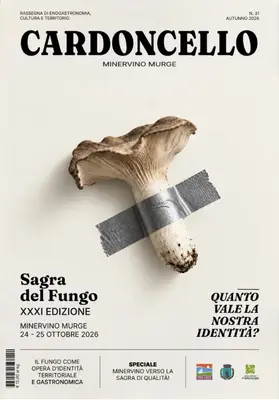
24/10/2026 25/10/2026
Festivals
A journey to discover the history and architectural heritage of Minervino Murge, through ancient alleys and panoramic viewpoints over the Apulian landscape.