Events Campania
Avellino Benevento Caserta Napoli Salerno
The Heart of the South
Campania is one of Italy's most fascinating and varied regions, located in the southern part of the peninsula and washed by the Tyrrhenian Sea. With its capital, Naples, representing one of the country's most important cultural and artistic centers, Campania offers a unique mix of history, art, nature, and culinary traditions. The region is world-famous for its archaeological sites, such as Pompeii and Herculaneum, for its enchanting coasts like the Amalfi Coast, and for the islands of Capri and Ischia. Its vibrant cultural life spans music, literature, cinema, and theater.
Historical and Archaeological Heritage
Campania is a region rich in history, with evidence dating back to prehistoric times. Among the most important archaeological sites are the excavations of Pompeii and Herculaneum, which were buried by the eruption of Vesuvius in 79 AD and are now UNESCO World Heritage sites. These sites offer extraordinary testimony to daily life in ancient Rome, with perfectly preserved houses, temples, theaters, and baths.
Other sites of great historical value include the Greek city of Paestum, with its Doric temples among the best preserved in the world, and the Archaeological Park of Neapolis in Naples, with its Roman theater and baths. Campania also boasts a rich medieval heritage, with castles such as the Norman Castle of Marechiaro, the Angevin Castle of Gaeta, and the Castle of Caserta Vecchia, as well as numerous historic villages like Ravello, Positano, and Amalfi, which retain their ancient charm.
Nature and Breathtaking Landscapes
Campania offers an extraordinary variety of natural landscapes. Mount Vesuvius, Europe's most famous active volcano, dominates the Gulf of Naples and represents a symbol of the region. Vesuvius National Park protects unspoiled nature, with hiking trails leading to the volcano's crater. The Amalfi Coast, a UNESCO World Heritage site, is one of the most beautiful coasts in the world, with its colorful villages perched on cliffs, hidden beaches, and terraced lemon groves.
The islands of the Gulf of Naples—Capri, Ischia, and Procida—offer exceptional maritime landscapes with grottos, sea stacks, and crystal-clear waters. The Campanian hinterland is characterized by mountain ranges such as the Lattari Mountains and the Picentini Mountains, offering hiking trails and stunning rural landscapes. Cilento and Vallo di Diano National Park, also a UNESCO World Heritage site, protects unspoiled nature and rich biodiversity, with wild beaches, rocky coasts, and medieval villages.
Art, Culture, and Traditions
Campania is a region rich in artistic and cultural traditions. Naples, the regional capital, is an open-air art city with churches, palaces, and monuments spanning from the Greco-Roman period to the Baroque. Among the most important places are the National Archaeological Museum, which houses one of the world's richest collections of Greek and Roman artifacts, the National Gallery of Capodimonte with works by Caravaggio, Titian, and Raphael, and the San Carlo Theatre, one of Europe's oldest and most prestigious lyric theaters.
Campanian popular traditions are deeply rooted in religion and folklore. Among the most evocative events are the Feast of St. Januarius in Naples, held on September 19th, during which the miracle of the liquefaction of the saint's blood is celebrated, and the Feast of the Gigli in Nola, a procession featuring enormous wooden structures decorated with flowers and religious figures, carried on the shoulders of devotees. Neapolitan music, with its classic songs like "O Sole Mio" and "Funiculì Funiculà," represents another important cultural tradition of the region.
Campanian Food and Wine
Campanian cuisine is one of the most famous and appreciated in Italy, with dishes reflecting the region's richness and variety. Among the most famous dishes are Neapolitan pizza, patented as a Traditional Specialty Guaranteed, "spaghetti alle vongole" (pasta with clams, garlic, and parsley), and "parmigiana di melanzane" (eggplant parmigiana with tomato, mozzarella, and basil). Second courses include "ragù napoletano" (meat sauce cooked slowly and served with pasta), "polpetta fritta" (fried meatball), and "pesce all'acqua pazza" (fish cooked with tomato, garlic, and parsley).
Campanian desserts are equally delicious: among these are "sfogliatella" (a pastry shell filled with ricotta and semolina), "babà al rhum" (a rum-soaked sponge cake), and "torta caprese" (a chocolate and almond cake). Campanian wines such as Lacryma Christi, Greco di Tufo, and Taurasi DOCG complete the region's culinary offerings, providing perfect pairings with local dishes.
Expand1 result found
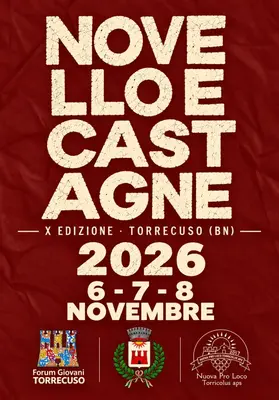
06/11/2026 08/11/2026
Festivals
Torrecuso celebrates the tenth anniversary of the Novello and Chestnuts event, dedicated to local food and wine excellence and the rediscovery of traditions.