Events Basilicata
Introduction to the Region
Basilicata, located in southern Italy, is a region of authentic and unspoiled charm, often referred to as the "green heart" of the Mezzogiorno. With a predominantly hilly and mountainous terrain, Basilicata offers breathtaking landscapes ranging from the peaks of the Apennines to olive groves and vineyards, down to the rocky coasts overlooking the Ionian and Tyrrhenian Seas. Despite being one of Italy's least populated regions, Basilicata boasts a rich cultural, historical, and natural heritage that makes it an ideal destination for travelers seeking authenticity and living traditions.
Natural Landscapes and Protected Areas
Basilicata is characterized by wild and suggestive nature. Pollino National Park, Italy's largest national park, extends between Basilicata and Calabria and hosts unique biodiversity, including the loricate pine, a prehistoric tree species and symbol of the park. The Lucan Dolomites, a karst mountain group, offer lunar landscapes and hiking trails of exceptional beauty, such as the famous "Path of the Poets."
The coasts of Basilicata are equally fascinating: to the west, on the Tyrrhenian Sea, the beaches of Maratea, an enchanting village nicknamed the "Pearl of the Tyrrhenian," are surrounded by lush vegetation and crystal-clear waters. To the east, on the Ionian Sea, the rocky coasts of Policoro and Nova Siri offer stunning maritime landscapes. Lake Monticchio, formed by two water mirrors within an extinct volcanic crater, represents another natural wonder of the region.
History and Cultural Heritage
Basilicata holds an exceptionally valuable historical and archaeological heritage. The city of Matera, the European Capital of Culture in 2019, is world-famous for its "Sassi," ancient districts carved into limestone rock dating back to prehistoric times. The Sassi of Matera, now a UNESCO World Heritage site, represent a unique example of rock architecture, with churches, caves, and dwellings blending into the rock.
Other important archaeological sites include the Greek ruins of Metapontum, where the Doric temples dedicated to Hera, Apollo, and Aphrodite can be admired, and the Roman city of Grumentum, with its theater and baths. Basilicata also boasts numerous medieval testimonies, such as Melfi Castle, Lagopesole Castle, and the ancient village of Venosa, the birthplace of the Latin poet Horace.
Art and Popular Traditions
Basilicata is a region rich in artistic and folk traditions. The Matera school of painting, active between the 12th and 14th centuries, left valuable frescoes in numerous rock churches. Lucanian folk music is characterized by the use of traditional instruments such as the bagpipe, tambourine, and ciaramella, which accompany dances and songs during village festivals.
Among the most evocative events are the Feast of the Madonna della Bruna in Matera, held on July 2nd, during which a statue of the Madonna is carried in procession and then symbolically destroyed in a ritual, and the Feast of St. Roch in Potenza, featuring processions and fireworks. Local crafts include pottery, wood, and wrought iron work, producing items that reflect the region's ancient traditions.
Lucanian Food and Wine
Basilicata's cuisine is simple yet flavorful, based on genuine and seasonal ingredients. Among the most traditional dishes are "peperoni cruschi" (crispy fried dried peppers) that accompany many dishes, "cavatielli" (fresh pasta shaped like small gnocchi) served with meat sauce or turnip greens, and "rafanata" (an omelet made with horseradish, eggs, and pecorino cheese).
Lucanian cured meats are renowned, particularly "salame di Senise," a spicy salami made with pork and chili pepper, and "capocollo di Senise," a seasoned cured meat. Among the cheeses, "Pecorino di Filiano," a hard cheese made with sheep's milk, stands out. Basilicata's wines, such as Aglianico del Vulture (one of Italy's most prestigious red wines) and Matera DOC, complete the region's food and wine offerings.
Expand1 result found
10/09/2026 30/11/2026
Festivals
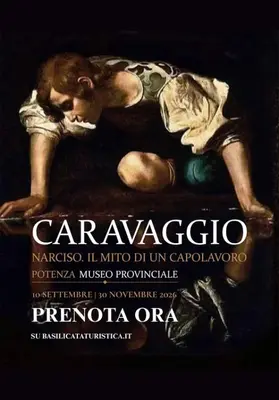
From September 10 to November 30, 2026, the Provincial Archaeological Museum of Potenza hosts Caravaggio's masterpiece in a unique exhibition journey.